1300 222 222

Member Opinion
Document Duty
Recently I ran across some old documents associated with my two years as Chair of Area F Southern Region. My heart lifted as I fondly recalled being part of the second life of what was one of AA Australia’s bolder experiments; a ‘micro-Area’. Given that it is now again not operating, I feel it’s important to document the critical events that led to Area F re-opening its doors in mid-to-late 2016, after its first hiatus of over 35 years. It would be a shame to lose touch again with such a fine example of AA innovation. It might also serve to remind the groups that make up Melbourne’s Peninsula District of how simple it would be to re-open the Area once again.
Why just these groups? Why just one District?
That’s actually the innovative bit. Since the early 1980s, the less-than-20 groups that sit within the Peninsula District make up an entire AA Area! The idea for this micro-Area came out of the remarkable mind of a Local Member*, who has sadly since passed. Over 50 years sober when I first met her, this Local Member*, was a true general service inspiration. I once caught her before a Peninsula District meeting outlining our service structure (complete with hand-drawn diagram) to a 6-week sober newcomer. Moreover, this newcomer was hanging off her every word! This Local Member*, was the first person who suggested to me it’s a great idea to start newcomers off with Traditions and a bit of service structure info. As she put it, “Not everybody is ready to do the steps right away, but it’s possible for a newcomer to break a tradition from their first meeting on. Better to start there”. I have long since adopted the same approach and it works a treat.
Another act of service this Local Member*, performed was to write up a two-page history of Southern Region Area’s C and F.
It’s a fascinating read, outlining a journey that began in the 70s when this Local Member*, was the Area C Southern Region Delegate. The struggles she faced got her and others thinking. I’ll let her pick up the story:
‘…the geographical area (Area C) was too vast and varied (metro or rural) for all groups to make it to Assemblies. We began to try moving the Assemblies alternating between rural and metropolitan venues but this did not draw people together. Rural groups went to the rural ones, metro to those in suburbs. We could never get all the Groups attending and participating in the activities of an Area so they were never achieving what their role was.’
The question I have whenever I read this passage is this; To what extent are other Areas experiencing the same dilemma today?
Yes, Zoom assemblies have really assisted, allowing us to even have our online Area A, but is it as simple as that? Would larger Areas still like to be smaller so that meeting face-to-face becomes more possible?
This Local Member* continues:
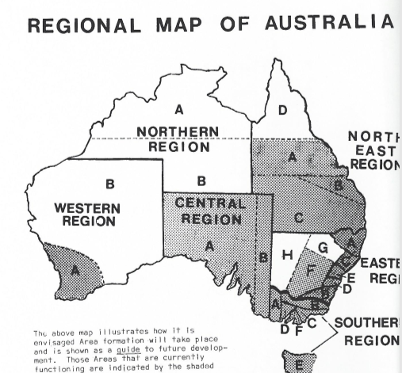
‘Meanwhile the Peninsula Groups had developed a strong sense of unity and service acting together to conduct the Peninsula Weekend. They gradually became frustrated with Area C, which was doing nothing about its role despite much encouragement from the Peninsula groups who were generally the main ones attending the Assemblies. Finally in 1983 the Peninsula discussed it and took the decision to apply to the National Conference to become a separate Area in its own right and abandon Area C which was totally non-functioning other than sending a Delegate to Conference. The Conference Policy and Admissions Committee consulted the Conference and then gave approval to the formation of Area F in 1983.
It’s interesting to note, I have scoured the 1983 Conference resolutions and have not found an Advisory Action that supports the above claim.
However, it could be that the decision was made prior to conference, as can happen sometimes. Either way, this Local Member* did decide to hold onto every scrap of documentation from this time; 17 different documents as I recall. This turned out to be critically important to the Area re-opening in 2016, but more of that later. For now, let’s return to Anne’s history lesson:
‘A Committee was established and a Delegate elected, Neil T. from Frankston. He attended two Conferences and then, in 1985, rotated out, as did the Chairman. Unfortunately, they did not manage to replace these office-bearers and little by little over the next 2 years the Area was unable to function through lack of candidates and members willing to serve. This Area, however, is still listed by the Conference as a legitimate Area and can be resurrected at any time.’
This Local Member* wrote her history only after Area F re-opened, thus what she writes about it remaining a ‘legitimate Area’ is not an opinion; it’s fact. Here’s how it came to be that way. In 2016 this Local Member* and some other Peninsula District members submitted their 80’s documentation to the Admissions Committee of AA Australia, noting that this committee could decide as to the legitimacy of their claim that (a) Area F existed and (b) it therefore could elect a new committee and participate in Conference again.
Now, before I reveal the Admissions Committee response, there’s one more thing that needs to be shared. The issues that this Local Member* raised regarding Area C inactivity seemed to have cropped up again in the mid-teens. In short, Area C had ‘gone dark’ as we say in general service. This led to half of Melbourne, and a big chunk of rural Victoria, being unable to fully participate in general service. This of course included the very active Inner City District (ICD). I won’t go into why Area C no longer had a committee; that’s definitely a different article for a different day. Suffice to say, at the time it was deemed easier to re-open Area F than get Area C going again, thus allowing ICD to once again participate fully in general service.
There was an issue though. How could an entire District join an Area that doesn’t share its geography?
The long answer is of course for Areas to apply to Conference to change their boundaries. However, given both Area’s F and C were both dark, how was such consultation even possible? How can non-Areas apply to Conference???
Hopefully, you can see now why the Peninsula District sought advice from the Admissions Committee. Here’s the letter the Chair of that committee wrote back in August 2016:
17 August 2016
To: Peninsula District Groups
The Conference Policies & Admissions Committee met by teleconference today, to discuss the possibility of a delegate elected by Area F Southern region attending the General Service Conference this year.
The Committee viewed documentation sent to them and three things are clear:
• Area F was indeed formulated in 1983, with Conference approval, and the elected delegate attended the General Service Conference that year.
• There is no evidence that even though this Area has not been active for many years, there is no evidence it was ever disbanded by the Conference. The committee was unable to establish when it ceased to be shown on the map of Areas throughout Australia.
• The Area approved by Conference covered the groups within the Peninsula District, Victoria.
The Committee were in agreement that, should the Peninsula District groups decided to activate Area F and appoint an Area Delegate, that Delegate would be admitted to the General Service Conference.
Inner City Groups, are part of Area C Southern region and cannot be geographically part of Area F Southern region unless the boundaries of both Areas were changed following a formal submission to Conference to do so.
Whether or not to allow Inner City District groups to participate and vote at Area F meetings would be a matter for the Area F group conscience. The following Advisory Action is relevant to this possibility:
Advisory Action #9/93
Conference agreed that it is the prerogative of all groups to decide on the location of AA Areas to which they wish to belong.
In Service
Delegate, Area B Central Region
Chair, Conference Policies & Admissions Committee
To this day, the above letter remains the clearest, most succinct example of the lower levels of our structure operating at their finest.
This one official document is all that’s required to assure anyone that:
- Area F exists, and has done so for over 40 years.
- It didn’t come from no-where in 2016. It had a solid, recorded past.
- It has geographical boundaries, just like any other Area (other than our Online Area A).
- ICD groups are seen that way – as groups, not an intact District. As such, technically, ICD was never part of Area F, just its groups were. In saying this, the ICD DCM had a vote at all Area F Assemblies – a nice example of the voting members exercising their right of decision in the matter
- There is in fact an Advisory Action (9/93), that allows any individual group in a dark Area the chance to join a functioning Area, as long as that Area wishes it to be so.
What happened to Area F after that? It sent a Delegate to conference every year until Area C re-opened some time after COVID lockdown. All the ICD groups went back inside their own Area, and as of now Area F is back in hiatus.
The point is it can now re-form a committee at any time. This leads me to pose a couple of questions. Given we have one micro-Area already, is it a potential option for somewhere else in Australia? Is it in fact a faster path to a true two-thirds Delegate majority at conference? Are micro-Areas something to consider in our ever-present goal of better carrying the AA message through effective, efficient participation in our third legacy of general service?
In the end, it’s every Area and Group Conscience for itself, right?
I’ll end on this Local Member* ’s parting words in her history of Area C and F, Southern Region:
‘As the result of the widespread ignorant attitudes, apathy and distrust of Service activities, my feeling is that only through the strengthening of local Districts and the proper support of grassroots members and groups will our structure and particularly our Fellowship be able to be rebuilt. Our AA message of Recovery, Unity and Service has been damaged, even trashed, and certainly lost to many members, but the Districts can restore this. A healthy Area is possible as the legitimate child of two or more Districts creating good grassroots foundations and joining one with the other.’
AA Member Albury NSW
* Local Member – Name supplied. Government regulations prohibit AA from using members names in part or full.
AREA MAP CIRCA 1984