 1300 222 222

Members Opinion
These are the notes from the Darwin ‘In All Our Affairs’ Wednesday Online Services meeting – 9th October 2024 presented by Ro G Corrimal Steps and Traditions Eastern Region Area D and Paul B Eastern Region Area G and a Past Eastern Regional Trustee.
Please note
- Extra information has been added to the information shared in the one-hour presentation to help explain some comments that there was not time to elaborate on.
- If you would prefer to hear the hour podcast of this session, instead of a long read, please contact us
- or just scroll down and look at the diagram 🙂
Presentation Introduction
Main Sections
- Introduction
- Current Australian Service Structure
- The Structure Review Plan 2015
- What has happened with Service Structure and how is it evolving?
- Can we afford to have the two arms of Service ?
- What could a Local Services Team Do
- What could a united service structure look like?
- What would need to change to make this happen?
- What could be the advantages/ disadvantages of a single arm of service model?
- Conclusion
- Appendices
The thrust behind this topic is an observation that Australia is moving towards a unified structure for AA Australia (i.e. Conference Topic 15 -2024) because we are too small a population in a big country to use
the American model.
It is important to remember
- The AA fellowship itself is based upon the experience of what works – The World Service Structure evolved i.e. In 1935, they did not have an American Two Arms of Service Model in mind (as originally they did not have the Traditions & Concepts etc. – they evolved too) so this was not imposed upon them.
- In the 1960s, the American Two Arms of Service Model was imposed over a State Service Structure in Australia, with many negative consequences and ongoing work to try to make this model fit for us.
- Despite this, the observation is that the revolution in technology is slowing evolving in Australia towards a more simpler one arm service structure.
Note: This paper about virtual service organisations is not advocating an immediate getting rid of physical offices but asking us all to keep an open mind and a willingness to change where we can so we can more effectively and efficiently “carry the message to the alcoholic who still suffers” – which is our single purpose.
Current Australian Service Structure
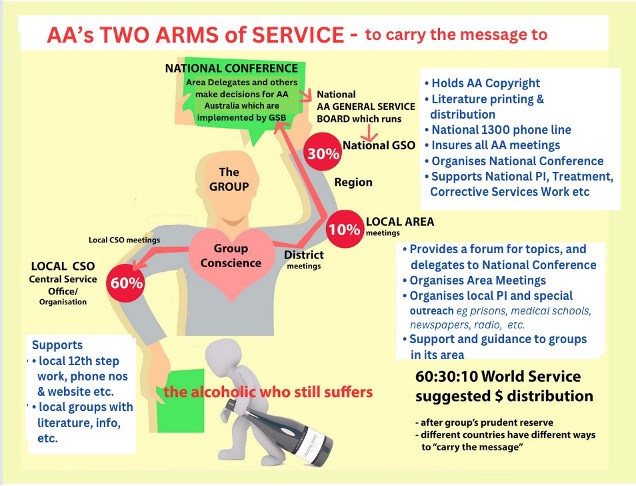
Two arms of service US model Australia adopted in the 1960s and imposed over an already established state service structure i.e. not evolved as it did in America based upon experience.
This model recommended the 7th Tradition Contribution Plan 60:30:10 – that is after group expenses and a prudent reserve, surplus funds are recommended to be distributed 60% to the local service office (CS0), 30% to the national office (GSO) and 10% to Districts/Area.
This topic of a better service structure for AA Australia has been raised a several times – See Key Conference Resolutions 1963 -2025:
Appendix 1 – See a few of these Advisory Actions at the end of this paper.
The American model uses US terms Central = Local i.e. centrally locatedand General = National i.e. generally available to everyone.
Please note:
- The AA fellowship itself is based upon experience of what works – an evolving structure i.e. in 1935, they did not have a World Service Structure in mind, nor the Traditions & Concepts etc. so this was not imposed upon them.
- The Observation is that Australian AA is evolving too.
- We are NOT advocating an immediate getting rid of physical offices.
The Structure Review Plan 2015
A major review of the AA Service Structures was done from 2015 to 2018
Paul B shared main points of this Review:
- The Structure Review Plan 2015 came about as the result of Conference Topic 008/2015 which stated, “That the Fellowship of Alcoholics Anonymous Australia takes its Inventory on how our AA Structure works in AA Australia.”
- The background or reason for the topic was: “We have a Structure in AA that was based on the Structure used in the United States that while it may work well in the USA may not be the best system for the Fellowship of AA in Australia”. ….. “New Zealand, Netherlands, UK and all these countries have adopted a system that works best for them rather than the US model.
- A Quote from the Big Book “A business which takes no regular Inventory usually goes broke. Taking a commercial inventory is a fact finding and fact facing process.” Page 64. Bill Wilson also wrote in the 12 & 12 on page 129. “The unity of A.A. is the most cherished quality our Society has. Our lives, the lives of all to come, depend squarely upon it. Without unity, the heart of A.A. would cease to beat; our world arteries would no longer carry the life-giving grace of God.”
- The suggested solution was “ Service Inventory separate from the Annual Service Conference”
- The benefit to the alcoholic who still suffers was stated as: “ We need to seriously look at the AA structure to streamline a system that works well for Australia and is more inclusive of the general membership & fellowship in Australia. This will build some enthusiasm to get people into Service to help in their own personal recovery. Bring the CSO’s and the General Service
Structure together and come up with a way forward to help the still suffering alcoholic rather than fighting each other and wasting resources and energy.” - This Topic 008/2015 was adopted, and Paul was asked to chair the Committee set up to review the AA structure as it existed and make recommendations to Conference. Initially 13 (11 delegates and 2 trustees), then 11 members who worked on the topic. This was very unwieldy as there were lots of different ideas about how to proceed.
- Fortunately, an AA member (Ken), who had been concerned for many years about this issue and heard that Paul was involved, contacted Paul with a very comprehensive and detailed review plan. Paul took this back to the committee to adopt this practical approach as an efficient and effective way to move forward.
- The Committee then adopted the Plan and the Investigations to compliment the review.
Paul then spoke about these two documents:
- Investigations document:
See Investigations June 2016.pdf
The Investigations paper had an Introduction; North America experience; History of the Structures in Australia (especially that our original structure was deeply entrenched on a state model – which caused a lot of hostility, division and poor communication between the opposing sides. NB It’s hard to know how the US model was adopted originally.);. Description of the General Service and Central Service functions; plus, a lot of detail about other countries. Then the paper had a very valuable section with their similarities and differences to the American Structure. Finally, the paper had a Taking Inventory section which looked at the options. The paper then had some statistics on other countries as best as could be put together at that time. Whilst part of this paper is now out of date, it gave the Australian fellowship a valuable snapshot of how things were world-wide in 2015 and contains great information. - The Review Plan document.
See Structure Review Plan June 2016.pdf
This paper was the actual Plan for the Review of the Australian Service Structure. Another extremely detailed plan to basically take the inventory of the Australian fellowship. It was very comprehensive in trying to sweep up every part of AA in Australia into a great big communication net to see if we could come up with consensus on going forward – if we needed to change. Being so inclusive alone created enormous push-back from certain sections of AA. What was great about this paper is that it outlines all the essential functions of service structure. It also looked at how to develop a representative body, with elected representatives to come together for a 3 day “group conscience” in Canberra. This was to be preceded by workshops organised by areas and districts all around the country. This was to try to get as much information, education and communication around the fellowship as possible. The purpose of this was to be a really important activity to unify the fellowship by these processes.
As a result:
- The two papers wereapproved by Conference in 2016 for distribution and discussion by the fellowship with the aim of Conference in 2017 considering adopting The Plan.
- Preceding this, there was an unusual event called a “Workshop Sharing Session” to try to gauge the fellowship reaction to adopting the Review Plan – no decisions, conclusions or recommendations were to be made at this time – as its aim was to enable conference delegates to discuss the issues involved. Was very interesting and there was a lot of push back.
- Ultimately the action was defeated by a small margin (60:40), certainly not a 2/3 rds majority.
- Looking back on this now, there were several reasons why it was not successful. The approach was too complex, too detailed, too careful and overly calibrated by trying to please too many people. So, it confused a lot of people.
- That said, it was a very interesting exercise, and some 20 odd workshops were held around greater metropolitan Sydney – which was useful in “educating members.”
Summary of the Review
It is possible to have a different service structure to the US model we currently have, and for Conference to make recommendations about this.
What has happened with Service Structure and how is it evolving?
Ro explained, that whilst she has been a GSR and been involved in areas, her service involvement has mainly been in the local (central) service arm, and that it is her experience that she’d like to share.
As an introduction, Ro reminded the meeting that the two arm service model evolved in the US, it was not imposed upon them, and that in her view, the US model was imposed as a blue-print over our state-based model, and we have been trying to make that work ever since.
In NSW the tensions were enormously high, with the result that many longer-term members stating that “service” was “politics” and so withdrew from any service beyond being a Secretary or Treasurer. This meant nil involvement in the general service arm, and some involvement with CSO arm as it supplied literature and meetings lists.
Virtual “Office” Examples
Ro G shared these points about her service experience beyond her home group:
Blue Mountains 1991- 1996
- 10 groups over 100 kilometres with a working committee of about 10 members
- Met monthly/ bimonthly at Katoomba for the day, holding a District meeting (as part of Area D) of the general service arm in the morning, and changing hats met as a Zone meeting (as part of the NSW Service Council structure) in the afternoon. And having lunch together.
- We established an answer-phone in a church cupboard in Katoomba, that we could remotely change the message with the meeting days/ times and phone numbers of local members to contact; A5 printed meeting lists; A4 size AA posters which we negotiated with the railway to
place on all the Mountains railway platforms; took over the payment of the weekly AA advert on page 2 of the weekly Blue Mountains Gazette newspaper (the only and widely read at that time); established the November Blue Mountains AA fellowship weekend which ran for several years. - Blue Mountains District via Area D put a paper on a unified model in in 1992-1993 but seems it never got up, as no record in the Key Conference Resolutions.
Looking back, whilst there was no internet available to most people, what we ran was a “Virtual” Office in today’s terms – but doing the two arms of service activities i.e. PI as well as local 12th step work and supporting local groups. (Since then we realised that the roles of a CSO and District are almost the same)
Southern Highlands 2008 – 2018
- 8-12 groups over 60 kilometres with a working committee of about 7 members
- Incorporated under the Dept Fair Trading as the Southern Highlands Central Service Office in 2008 (but encouraged groups to align with Area B) because the Wollongong CSO (Area D) could not service our geographic area (up over the escarpment up the Macquarie Pass or via Picton Road)
- Met bimonthly at Bowral for 2 hours at the Uniting Church, which kindly dedicated its basement for use by 12th groups, along with a dedicated storeroom (and still does).
- We established a two bank accounts (one community saving, one debit card with low limit
for credit card payments) - the aash.org.au website using CSM software, which had a public facing section with meetings list, FAQ and information for local groups as well as a members
only section where we could store out minutes, bank statements, incorporation documents
etc; - a professional answer-phone service with Telstra for several years, that we could remotely change the message with the meeting days and times and phone numbers of local members to contact – then in the couple of years a VOIP virtual number that we could program remotely to local members mobile for 12th step calls;
- arranged Big Books to the local libraries;
- A5 size AA posters for GPS and other venue;
- arranged free ads in a local weekly tourist type publication (newspapers were too expensive – though we were able to arrange a couple of AA stories with one paper);
- arranged a free twice daily 30 sec AA service announcement on
the local community FM radio Station; - for many Christmases ran 4 ads (Fri, Sat, Sun, Mon) on commercial AM radio;
- did two mail-outs to all the GPs in the Highlands with letter, poster and
AA business cards (local phone and website); - ran two AA in Autumn weekends; during the first round of Covid,
- we arranged an AA zoom account for local groups to use.
- Whilst we did hold stock for sale from the Church Storeroom (in the room where 4 of our AA meetings were held), the GSO allowed us to order literature for the outer groups to go directly to the group (avoiding double handling), but the CSOSH were invoiced and paid the bills, recouping the funds from the group.
So, we ran a “Virtual” Office” – but doing the two arms of service activities i.e. PI as well as local 12th step work and supporting local groups. The CSOSH closed as some of our Committee died and others moved out of area. Meetings had closed during Covid, but the “Service is Politics” attitudes remain amongst those groups still operating in 2018.
Perth & Wollongong CSOs in the 2000s
Ro made a few comments in relation to these. Mainly that she understood:
The Perth CSO to be the States’ one office that:
- most WA groups send all their donations to the Perth CSO which it then distributes as per the 60:30:10 (or in what-ever proportion the
group’s nominated split is); - orders literature from GSO to go directly to groups, given the size of the state and the cost of postage (if they were to do double handling).
- organised incorporation as recommended by AA;
- does the updating of the national meetings directory for WA;
- runs a website www.aapertnhwa.org
- and more
The Wollongong CSO
The Wollongong CSO services the Illawarra, South Coast and Far South Coast (Helensberg to Bega) that:
- pays $80 per week for 2 rooms upstairs in an old building at
Fairy Meadow – not wheel-chair accessible; only has sufficient volunteers to staff the office for 3 x 5 hours per week; - but it does hold good supply of literature stock, banners and
medallions etc. - Its website www.aawollongong.com.au now has a section for meetings that
are connected by images to the national meetings database – see
www.aawollongong.com.au/meetings. - The CSO and/or the groups arrange for the national meeting list to be updated, meaning that the local website is automatically updated.
- A two-page pdf from an .Xcel based meeting list, is provided by the CSO for groups to print
double sided, but this is increasingly unnecessary as most members now search on their mobile phone for meeting information
Note: Since this talk last year, several actions have been taken by the Wollongong CSO including
- incorporation in NSW as a non-profit community association including the general service structure principles (ie could be used for a District/ Area or CSO
- a planned move as the office’s building sold, and the rent proposed increased to over four times what it had been for last 20 years.
- For Wollongong’s latest News and Constitution see here:
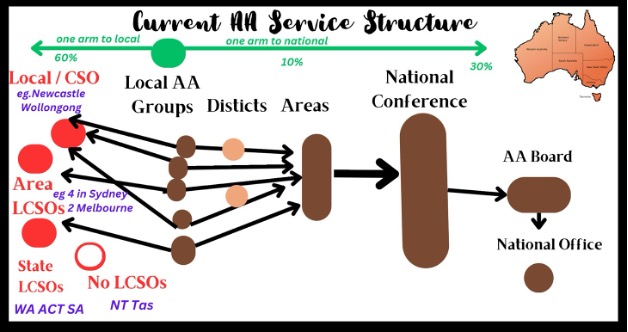
So, this seems to be the current AA Structure evolving in Australia.
NB Comments by participants on the Zoom Meeting
- Brendan D made the comment that
a. Victoria has a CSO at Richmond and within 5 kms there is a CSO at Prahan, that formed their own office.
b. Also, a phone service in Bendigo. NB Added the 2 in Melbourne CSOs to the diagram above. - Rebecca S clarified that it was the North-West Intergroup (another name for a CSO) that used to coordinate the phone line.Although it has not been operational for some time, this N-W Intergroup merged with the Richmond phone service.
- To see the current list of CSOs
- Paul B corrected the impression that the diagram showed some CSOs being run by Areas.They are not – have their own boards etc, but service an area, not a district, nor a state/territory or a defined regional (non-metropolitan) area like Wollongong or Blue Mountains or Southern Highlands i.e. proper CSOs not Area-affiliated. The above diagram has been corrected to remove that impression.
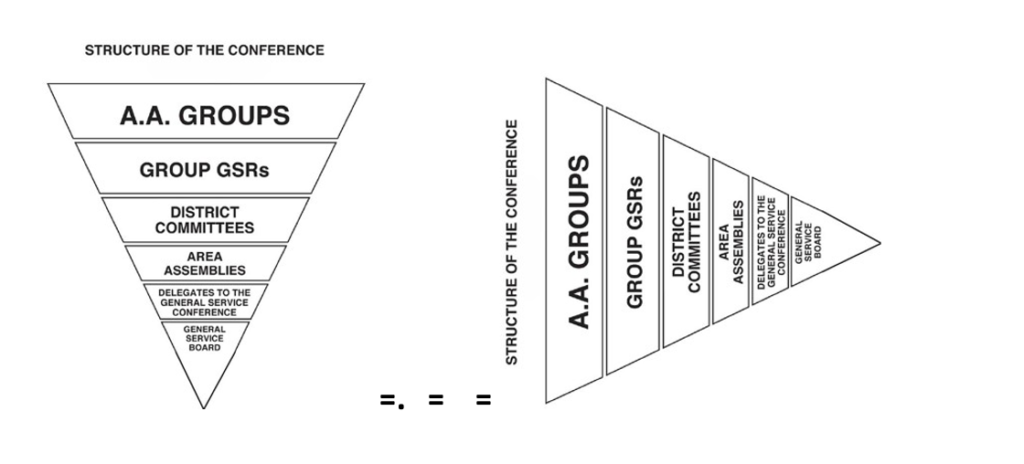
Note: Not in the presentation – This Triangle Diagram below represents only ONE arm to National (General) Service = to align with the above should be turned on its side.
Sydney City Office (Area G) 2000s-2024
Paul was asked to comment upon the CSO in Sydney that is taking a formal step to merge the CSO and District/Area in line with the trend we are discussing tonight. Paul made these points:
- Paul chaired the Sydney City CSO Committee in the early 2000s. It was getting plenty of financial support from the groups coming in, but groups were not sending any reps to the quarterly meetings, and thus the Sydney CSO was not getting any direction from the groups (as per AAs bottom-up model).
- So, the Sydney City CSO was accumulating money with no stated aim, which Bill W warned against.
- At the same time, Area G that the Sydney CSO serviced, was flourishing with lots of subcommittees of interested members and were coming up with lots of ideas for PI activities but had no money with which to operate – because the 10% for District/ Area is basically money to send Area Delegates to the National Conference and cover associated administrative expenses.
- So, these Area Committees were coming cap-in-hand to the CSO for access to the funds, but the CSO could not release these, as it did not have the permission of the groups that financed the CSO to do so.
- This highlighted the short comings in the current structure. When The Structure Review Plan was flagged but looked like falling over, the local groups decided to act anyway – on the basis – Each group is autonomous – Each Area is autonomous e. “we can do what we want”.
- Therefore, in March 2017, the proposal was put “that the Sydney City CSO and the Area G to combine into a single service entity” and agreed to. It was also agreed to have a one-year trial as recommended by Bill W. This was extended out to another 3 years.
- At the end of this time, it was agreed that the experiment was working well, and that the amalgamation would proceed. Some more work was needed in defining some aspects of its operations and deciding whether to combine the two previous bodies financial accounts. The later has been done, the body has a single Treasurer with the one account for its operations. i.e. last-minute actions are being tidied up now.
- Paul also reported that their group has been invited next week to share their ideas and processes with the St Ives Office Northside Office who are considering a similar approach.
This, Paul considers may be more difficult as they have been established much longer than the Sydney City CSO.
- St Ives were having similar problems to Sydney City CSO with lack of participation of the groups.
- In summary, this approach results in each groups sending a single rep. to Area and all matters about the CSO/Area body are voted upon at the quarterly meetings.
Can we afford to have the two arms of Service?
Questions for us to consider:
- Can we afford to have CSO and Districts
- Are CSOs duplicating services we already have?
- Are we open to doing things differently?
- Why may we need to?
A lot of change has happened since the 1960s, even since the late 1990s. We now have:
- a national website
- a national meeting list data base
- a national Chat function on the website
- a national 1300 number
- a national literature shop
- national committees for PIPA, Treatment & Accessibilities; Corrections; Technology & Social Media etc…
- national AA Around Australia and other national online publications
- And lots of competition for AA from community groups like Smart Recovery, D&A services, other 12th step programs etc.
- Literature distribution, in particular, has undergone major change. This was GSO & CSO main source of income.
So now income is reducing as Literature is available on-line
- on websites and as pdfs, and via apps. etc. e.g. Everything AA app (which would be good if AA had its own).
- Paper copy is going out, and we remember that it is the information that is important, not
whether it’s in a paper form or not. - Also, viscous circle for CSO, need an office to store the literature but in turn must pay rent,
which is increasing. - So, CSOs are duplicating the storage of AA print materials
- But now double handling as well (came when CSOs closed during Covid, which some viewed
as negative, but can be seen now as an opportunity). - A National Literature Distribution Centra would be more efficient.NB There is a way to distribute literature income if eventually all was distributed from the GSO i.e. a percentage of sales each quarter via postcode.
Meeting lists
1. Now have a national data-base – if all groups updated their local office information directly via aa.org.au, and
2. local websites linked to the Meetings Subdomain
3. there would be fewer errors, and less duplication.
NB there is a capability to store group’s contact information confidentially in that software, so those working on the ChatNOW could communicate with the Meetings Updaters to have a local person contact the newcomer directly.
Answer phones 1300
- links via divertors phones currently (via Postcodes)
- Enormous effort required to establish, manage and monitor phone rosters of local members for the 1300 to switch to after-office hours for the CSOs
- Could have a national roster like ChatNOW (840 newcomers per month/ 210 per week/30 per day – See Appendix 2) which would simplify this effort, provided it was set up with clear guidelines and training to link newcomers to local groups and local members.
Websites
Whilst it is duplication, there may be benefits in local ones or local specific information, provided they link to the national meetings database and other national information.
Organisation:
Running an office requires much more labour, time, energy, resources and legalities – for example: incorporation; ABNs; Charity Registration; ATO reporting; secretarial work, minute taking; treasury/bank accounts etc; individual volunteer time & meeting time and so on.
Public Information
If part of a CSO objectives (e.g. PI is part of the Wollongong CSO Constitutional Objectives) – Needed more than ever for the fellowship to carry the message and grow.
What could a Local Services Team Do?
Most people think the following are the roles:
CSO functions
- meet regularly
- hire a room monthly or bi-monthly
- have a group .gmail account / What’s app for communicating amongst themselves (or use a national web forum under members.aa.org.au)
- have one bank account for groups to donate for (60:30:10 distribution)
- have a local website (?)
- support local groups in having regular Group Consciences and run workshops
- maintain a list of members willing to take or make 12th step calls
- add what you think
District functions
- have a .gmail email contact and business card for their PIPAwork
- distribute AA cards/ posters to police stations, GPs, health & welfare centres, courts
- arrange free community radio /tv ads
- have info stands at the local annual mental health /aged care/youth service forums
- arrange professional PI activities (e.g. Newcastle professionals’ seminar with Dr S Jurd.)
- add what you think
Note: When comparing the CSO roles from the Australian Group Handbooks and the role of the District in the Australian Service Manual there seems to be only the distribution of literature as the major difference.
What could a united service structure look like?
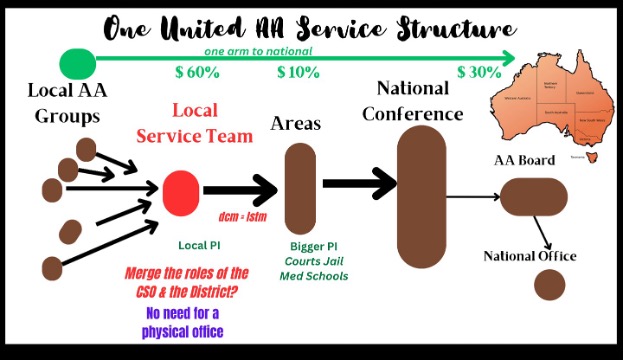
Keep it simple :
- needs to be easy to explain to the newcomer
- groups send their reps to local Service Teams, rather than 2 bodies, and then in-turn to Areas etc.
What would need to change to make this happen?
- Merge the roles of the CSO and the Districts. NB Such bodies may or may not retain a literature distribution role.
- Change the language we use to Aussie friendly terms e.g. Name the merged bodies Local Service TeamsNB changing a name of an incorporated body is not that difficult. Adding a PI function into their objectives if not there already is not difficult either.
- Revise the Australia Service Manual sections that would need the name and role changes i.e. Districts and CSO section deleted, and the Districts and District committees replaced with Local Service and Local Service Teams respectively.
- Broaden the role of the National Literature Shop to be the main distribution centre selling literature directly to groups.
This can be shown as : (New diagram – Not in the presentation)
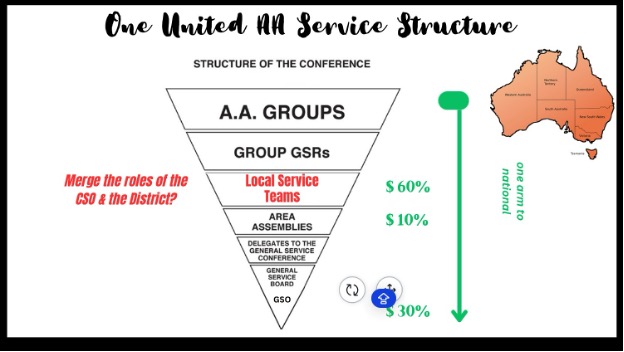
NB The cost to implement these changes is minimal compared to the cost savings.
Comments:
- Brendan D noted that in Victoria
- from West to East the fellowship has shrunk
- post Covid 2019 there is a lack of people to do service
- Change in Lifestyle has also impacted people making it more difficult to participate (Ro commented people are time poor and so virtual options help bridge our distances in Australia)
- Question – how do we maintain a democratic bottom-up organisation in these conditions?
- Supports Paul B comments to leave it to the membership, but make sure they are informed.
- Produce the Pros and Cons as a simple form
- The main question is “Does our Structure serve the function of AA in Australia
- John H noted this session as helpful
- Because for many years, John has seen the downturn in service
- John has until now, been somewhat resistant to change until he attended a local area assembly on the topics and noted that there were 20 people present – half with lap-tops, and John the only one with pen and paper.
- Can see this now as a natural progression into Area.
- Rebecca S made an observation
- Rebecca came into AA about 5 years ago, just before Covid, and was fortunate enough to have 3 months of face-to-face meetings
- Covid was a disruptor for the world including AA in her home group
- We have had to go through a process of re-educating, passing on the message of what service is to younger members in recovery
- Still see this as a challenge
- Rebecca hopes we can harness the knowledge of the older longer-term members in mentoring the newer members in service, and moving with the times a little bit more
- And not get too bogged down in much of the detail.
- Ro noted that
- she understood many years ago the General Service made a decision to only communicate via the Area – believing with would encourage groups to get active in Areas.
- this has not worked because this information has not got down to the groups.
- Communication is a major problem and
- hopes that the work of the Technology and Social Media Working Group will help to reduce these problems
- And stressed we need each other and need to work together.
5. Dale A has been involved in the Virtual area from its inception two and half years ago, and notes
-
- The area is going really well.
- Has over 30 groups who are regularly engaged with the Virtual Area.
- Have a mixture of longer-term and newer members which is really good.
- Are very active – have a series of sharing (?) sessions with specific session around how to run their groups that are virtual only.
- Some issues cannot deal with as we are only one arm of the service structure, as being broadly distributed cannot serve in geographically based CSOs
- These members are very willing but have no avenue / structure within which to work.
- Interested in hearing more and be involved in subsequent conversations
NB Ro commented that we need to find ways to do this, that does not end up with one virtual fellowship and one face-to-face one – need a way to integrate both.
And in face-to-face we get cake!
6 Brendan D agreed with Rebecca about:
- the capacity of longer-term members to communicate with newer members was important
- the general communication right across CSO, GSO etc, needs to be open and honest
- having straight forward conversations on what the service structure and the communication structure need to be so we can go forward.
Paul made the final comment of the presentation – it’s really important that we keep our service work FUN!
What could be the advantages/ disadvantages of a single arm of service model?
Ran out of time to explore this question.
Advantages?
- Better Communication
- More effective and efficient volunteers’ work
- Younger members stepping up with digital skills
- Older members providing wisdom and support
- Better use of time in a time-poor world
- Better use of financial and other resources, by minimising duplication
- ….
Are there more advantages or other ways to achieve the same goals
Disadvantages?
- Offices provide somewhere to go for non-working and visitors AA members
- Not all AA members are able to participate with the virtual world, because of geographical location (g. see the Telstra map of cover across Australia as Telstra only covers some areas), personal finances (e.g. DGRs Digital radio system works on satellites are really expensive)
- …
Are there other ways to meet the things that these disadvantages provide? i.e. personal interactions outside the meetings – somewhere to be.
Conclusion:
It is hoped that this paper will provide some understanding about how AA in Australia is evolving and provide some direction (or vision) for how the fellowship may evolve in the future.
Meeting finished with the 7th Tradition message (with the QR Code), quote from Bill W (page 134 Language of the Heart) and the plural form of Serenity Prayer.
Contact: Ro G and/or Paul
Note: Since this session, an update could be simply as The Sydney City CSO merged with Area E with its own Committee and formal link to its Area E Committee, a CSO could simply become a District or Area Office depending on the most functional arrangement – Visualised like this:
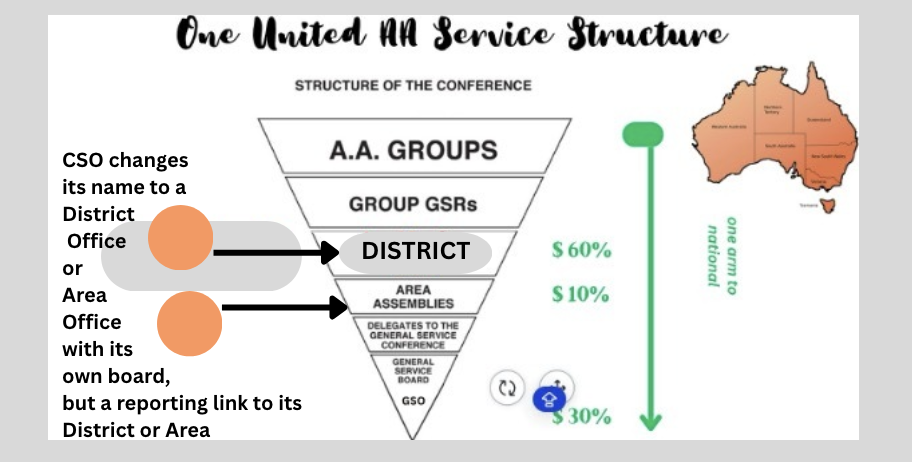
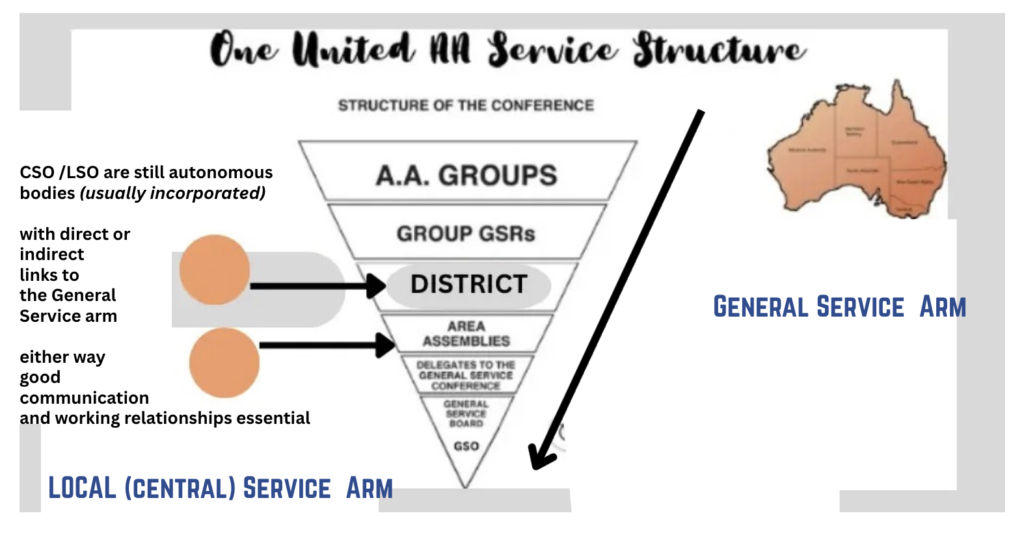
Or we could think about this as being UNITED WITH 2 ARMS of SERVICE – but formal or informal links to a Direct or Area or even Areas of the General Service Arm as appropriate.
Appendices:
1. Some Conference Advisory Actions:
Advisory Action 1994/031 allows a General Service Trustee, Trevor H, to analyse tape recordings of the presentation ‘AA Takes Its Inventory’, the question-and-answer session after, together with the session ‘How Do We Attract More Groupsinto the General Service Structure?’
Advisory Action 2011/053 circulates the following statement so that all members can share in the principles of recovery, unity and service that Conference embodies. This message “summarises Conference’s commitment to the long-term health of our Fellowship”:
The 2011 General Service Conference affirms that:
- It appreciates that all AA members share a great passion for our Fellowship.
- It has a duty to support all members and Groups across Australia. It operates according to a body of principles and relationships by which AA can function as a whole. This may require it to express a view on vital AA policy matters or on any hazardous deviation from AA Traditions.
- AA Groups are autonomous and the primary source of authority for the Fellowship. Accordingly, Groups can decide to which AA service entity they donate member contributions.
- It is the guardian of AA world services for Australia and accepts its custodianship of the Twelve Steps and the Twelve Traditions and its obligation to assist in carrying the message in Asia and Oceania.
- Separate General Service and Central Service structures are essential to carry the message in Australia.
- The most effective way to carry out the function of Conference is through a single General Service Office.
- The General Service Board is empowered to act on its own responsibility, within the provisions of its own charter and by-laws.
- Carrying the AA message in Australia is substantially funded from profits made from the sale of AA literature. This requires the General Service Board to hold the Australian copyright, protect AA trademarks, approve, publish and supply AA literature to members and the public.
- The existing AA public liability insurance continues to protect group office bearers against being sued in the event that damage occurs at a meeting. A single national public liability policy reduces the risk of that insurance cover becoming the subject of dispute.
- It understands that Conference is not a seat of power but needs to act in the best interests of all members attending the 1,938 AA meetings listed on the AA website.
- Any issue that significantly affects the Australian Fellowship must in future receive at least a two-thirds majority vote at Conference, and
- It will do everything possible to avoid any punitive action on members or create public controversy.
Service Structure Review
- Advisory Action 2015/008 resolves (carried by a show of hands) that a committee of 6 Delegates (a balance of 1st,2nd and 3rd year) and 3 Trustees be formed to investigate information contained in the background of Topic 008/2015 and to formulate a plan of how to conduct an inventory of the Australian AA Structure.The plan to be brought back to Conference next year.
- Advisory Action 2015/025 resolves that the topic (regarding regions and States not being part of our Fellowship’s structure) be added to the plan for conducting an inventory of the Australian AA Structure (Advisory Action 2015/008)
- Advisory Action 2015/040 resolves (28/1/1) that the topic (regarding whether non-Area Delegate Conference Members should have a vote at Conference committees) should be added to the plan for conducting an inventory of the Australian AA Structure (as per Advisory Action 2015/008)
- Advisory Action 2016/058 resolved (28/1/2) that the plan submitted by the Structure Review Committee be updated and circulated as a 2017 Conference Topic by the Conference Agenda Committee as soon as possible to give members and groups adequate time to discuss and provide feedback to their delegates.
- Advisory Action 2016/059 recommends (30/0/1) that the Conference Agenda Committee set up a special four-hour session at the beginning of Conference 2017 to discuss the Structure Review Plan.
- Conference rejects (28/0/3) Topic 2016/025 about regions and States, pending the outcome of the plan submitted by the Structure Review Committee.
- Advisory Action 2017/001 resolves (14/9/5) that Conference undertake an inventory of the Service Structure and produce a simple plan to achieve this.
- Floor Action 2017/001 resolves that a plan be adopted for the Structure Inventory. 2 Members from each region, no set time limit, a discussion paper be produced, an online survey be produced in 2018 and in 2019 a white paper be circulated.
General Service Structure
Advisory Action 2018/036 Conference accepts that no further action be taken following review of all documents presented by the structure review committee.
- What is ChatNow?
ChatNow is an online platform run by fellow members of Alcoholics Anonymous (not by the GSO). We have been live on the AA Australia Website since November 1st, 2023. In that time, we have responded to over 16,000 online chats and from those chats more than a third have been from newcomers reaching out to AA for the first time, on average we respond to 840 newcomer chats per month thus far*. We believe that this platform has benefitted AA through having further reach to the still sick and suffering.
Learn how you can participate in 1 of AA’s 3 legacies from the comfort of your own home on a desktop or laptop ChatNow is looking at expanding our responders’ group, don’t hesitate to join us online for our information evening. If you are able and wanting to be of service, help carry the message and be on the front line for the still sick and suffering then we would love to have you. 2 years minimum sobriety with a clear and thorough understanding of the AA Traditions
Contact the ChatNow Chairperson: ([email protected])
*Data as of May 2024
